Showing posts with label Alberta Beef. Show all posts

Thursday, 30 June 2011

It's Showtime!

I love to show off... but I'm not talking about showing off myself... I love to show off my cattle!

If you have ever heard of a cattle show, this is what I am referring to!

What is a cattle show?


A cattle show is just like any other type of show, like a car show or a horse show.  It is a way for cattle producers to market their product, hear about what the industry is looking for and compete against one another for the top cow!  The video below gives you an idea of just what a cattle show looks like! The video is from a fair in Prince Edward Island, but cattle show are fairly standard around the world!


At a cattle show, exhibitors compete against other cattle in their breed for a chance to be number one.  A judge enters the show ring and judges the cattle based on which cattle he thinks have the best conformation.  Conformation:  the best body structure, the best structural soundness, the animal that carries itself the smoothest when it walks in the ring.

Cattle shows not only market the cattle, but at most shows there is a chance for people to market themselves!  Junior shows are cattle shows that only allow young ranchers to take part, usually ages 9-21, with some shows starting at age 3 or 4 to age 24.  At the Junior shows, there are always a bunch of competitions for the junior showman to compete in, all testing the ability of the showman having nothing to do with how good the cattle themselves are.

Junior shows contain many different components to the show including:

  • Showmanship- the junior showman competes against the other showman to see who presents their cattle the best.  They are judged on how well they can handle their cattle, how well they set their cattle up, and how well they present themselves and the cattle.  A showman needs to be well groomed also.  The biggest job of the showman is to best present the calf to catch the judges attention.  If a showman doesn't do a good job of showing the calf, the judge may overlook just how great the animal really is, which could cost the showman and the calf a chance for the championship!
  • Grooming- There are competitions in which the showman has to groom their calf.  The showman are judged on which animal looks the best.  No calf should have any bedding on them, dirt, or mud.  They should all be washed up and squeaky clean.  The calves should be clipped and shaved properly, hiding the bad points and highlighting the strong points of the animal.  An animal with a thick hair coat is the best for grooming because you can easily work with the hair to shape it and hide weaknesses.
  • Marketing - This blog is an example of a senior marketing project for the Summer Synergy Livestock Show.  In the past I have had to make business plans, marketing strategic plans, present ideas for new products, create various products and ideas, and work in groups to market random items.  This all helps the youth get involved, learn a variety of skills and work on their innovation!
  • Quizzes- many shows have quizzes about livestock and agriculture that competitors have to take for points toward the aggregate (overall winner).  
  • Judging - At summer shows all the juniors have to judge everything from dairy and beef cattle, to crops, grains and heavy horses.  Upon judging a class, the competitor has to orally give his or her reasons to a judge.  The judge marks the comments based on quality of the comments, as well as how close the competitor was to judging the class the same as the overall judge. 
  • Art- Sometimes shows have art components such as photography, painting, drawing and various other categories where competitors can show off their other talents in a way that relates to the agriculture industry of course. 
The Summer Synergy Show is a show which combines Beef, Dairy, Sheep and Heavy horse shows as a way of "synergizing" agriculture and the youth involved.  
Shows are a great way to meet people and work at goals, as well as set up future ties in the agricultural industry.  The other showman competing against you at a show are someday going to be the other farmers and ranchers working with you in this great industry.  Youth Shows give young ranchers a head start on networking and setting up good markets for themselves!


What qualities does a judge look for in the champion?


When you step foot in a show ring, you want to be able to pick out which animal will perform the best out of the show ring.  The main goal for any farmer is to raise beef cattle that are productive and can bring him high quality beef.  As a young rancher, I need to be able to go to the pasture and judge the cattle, so that I can easily pick out the more superior cows.  No one wants a sickly, poor producing cow in their herd.  Learning how to judge beef cattle helps farmers improve their herds and make them the best they can!

Before the cattle come into the show ring, the judge sets him or herself up in the middle of the ring, this gives him a good spot to view the animals as they enter.  When the cattle enter the ring, their showman lead them around the outside of the ring in a clockwise fashion.

Having the cattle circle the ring once before they stop allows the judge to see how well each animal carries themself as they walk.  As a farmer, we want cattle that are going to be able to move freely over the pasture in order to stay healthy.  They need to be able to walk good and have good feet so that they can support themselves and a calf.

The first thing the judge does is inspect the group as a whole.  Usually there are one or two animals that really stand out to the judge as being at the top or the bottom of the class (the best or the not so best).

After one circle of the ring, the animals line up head to tail down one side of the show ring.  The showmen now set up their calves feet! 
As a showman, it is important to properly set up a calves feet when they have stopped.  As a showman it is your job to make the calf look its best in the show ring.  You want to highlight the good, and try and hide the bad.  
Harvie Ranching Ms Nylon 102U and Ricochet heifer calf
As you can see in the picture above, Jill and Cole have the cow and calf set up slightly different from one another.  This is because not every animal is the same, so as a showman you have to know how your particular animal looks the best and work with them.  Jill has the calf's left back foot slightly forward; Cole on the other hand has the cow's left back foot forward, as well as her right back foot slightly farther back.
Colorado State University did a great job explaining everything from halter breaking to showmanship here, they also have really good pictures, so check it out! 

The judge is looking for natural muscling of the animal over the loins, shoulder, rump and round.  This is how they judge the beef quality without actually seeing the meat!  When judging steers, the judge is looking for cattle that are finished.  Cattle that are heavy enough, without having excessive fat.  They are also looking for a "good spring of rib", or a voluminous rib cage, deep and wide, in which the animal can have extra intake.  
The cattle should have a straight topline, meaning their back should look nice and straight and from their back to their belly you should be able to imagine two horizontal lines making a rectangle.  
The judge also needs to recognize that not every breed has the same characteristics, so they need to take into account how well that animal does in their breed category! 
The judge also needs to know what to look for when judging a bull, a cow, a steer and a heifer.  These animals cannot be judged using the same guidelines.  For example, on a bull or a bull calf the judge needs to take into consideration the testicle development, scrotum size and attachment.  On a heifer or a cow, they judge needs to look at udder development, teet placement, calf size, and femininity.  

There is a great deal more to do with judging a beef animal and I would love to get more detailed in it in a later blog post, so stay tuned! For today however, I must move on! 

How do you get a cow ready for the show?

Preparing a show cattle takes days and days of work.  Instead of listing it all out for you I found a couple of videos that are awesome and informative and can give you the inside perspective of showing cattle! Enjoy!


The Apicreativemedia Channel on Youtube does an awesome job breaking down the entire showing process!   From feeding, washing and clipping, right to the show ring, they have covered it in two short videos! Check them out below!


Thanks again for following and reading! Stay tuned, much more to come!
Now it is time for me to head outside and get my own show cattle ready! Off to wash and clip some calves!

Sam

Wednesday, 29 June 2011

Five Nations Beef Alliance - Young Rancher's Video


Remember when I told you I had the opportunity of a lifetime this past year, having the chance to be part of the FIve Nation's Beef Alliance Young Rancher's Program? Well, our video is finished!
For those who don't know, in January I took part in the Five Nations Beef Alliance Young Rancher's Program in Denver, Colorado. I got to meet with people from all over the world, young ranchers just like myself.  I also had the opportunity to listen to and chat with highly respected cattlemen in the cattle industry.  I listened to speeches and had round table discussions, and through these discussions realized that even though we live in completely different countries, as young ranchers we all face the same trials and tribulations.  I feel that this is a huge step forward as a world industry.  By realizing that we are all the same, some excelling in different areas, I hope that the future generation can join forces and collaborate to help one another, share ideas and work together to feed our world.  I heard a saying over and over again during my time in the Cattlemen's Young Leaders Program and I truly feel this sums up the beef industry - We love the animals, we love the land, and we love feeding the world.  That is why we choose farming as a way of live.  It isn't always rewarding, but it is what we are, it defines us, it is a passion.
So now that you have heard me ramble, check out the video, it tells our story!  


Young Ranchers with Dr. Temple Grandin - Denver, Colorado

Friday, 24 June 2011

Bucks For Your Beef, Or Beef For Your Bucks?

A blog follower recently asked me about the cost of raising cattle, and as a farmer, where our income comes from.  What an awesome question! Of course people who don't live on a farm really only see the prices on the meat that they purchase in the supermarket, and it isn't the money from those packages that are coming to the farmers!

So bare with me while I try to break down some farming finance for you! 

My family runs a commercial cow/calf operation as well as a grain operation.  This means that we have two sources for income, the cattle, and the crops.  But this also means we have two sources for cost.

When I tell people that we have crops and cattle, their immediate reaction is, "wow, you must be rich".  Rich as in lifestyle rich, yes.  Rich as in monetary rich, not quite.  They immediately think strictly of the income.  But what most people don't take into consideration are all of the costs that come with farming.  So I am going to lay it out on the line for you!

Keep in mind, that the cost will be different for every farmer.  Not all farmers swath graze so they will have higher feed costs.  Some farmers calve all of their cows indoors so they won`t have to use as much bedding, but they will have higher electricity bills.  Not every farmer feeds the same type of feed and the same quantities, so you get my point.

We'll start with the spring.

Spring

This is a busy time of the year on our farm.  Our cows are all calving, and it is time to start seeding the crops.  
Your immediate thought is probably "baby calves = money in the bank".  This is true, to an extent. 

Now, what you didn't consider:
  • Calving. When a new calf is born we give them shots and they have to get their CCIA and RFID tags (read about this in the "All Things Agriculture" tab under the Traceability topic).  These all cost money.
    • A tag applicator can cost anywhere from $15-$50.  Now you don't buy these every year, in fact, if you take care of them they can last for many years, but they still depreciate and they are still a cost
    • RFID Tags and CCIA tags cost roughly $4.00/calf. 
    • Shots- Vitamin ADE and Selenium.  A 100 mL bottle of Selenium will treat roughly 50 calves.  So we buy 4-5 bottles a calving season.  The bottles are usually $30-$40, so if you divide $35/50 calves, it is roughly $0.70 a calf.  For the Vitamin A,D&E injection, we can treat all of our calves with one 250mL bottle.  
  • Calving. On our farm we calve our cows from March to May.  This means that calves can be born in pretty cold conditions.  Since the weather can be so bad, we have to bed our cattle (make them beds out of straw) to make sure they are comfortable and warm.  The cattle also need hay and silage for feed during this time.  This means that we have to use more diesel in the tractors and more straw bales, as well as more feed than in the summer.  This all costs money.  
    • Right now, round hay bales (roughly 1000-2000 pounds) are selling for 45-80$, depending on the quality of the bale.  We were feeding our 200 cows, 1-2 round bales of hay a day, as well as silage.  So that would be roughly $120 dollars a day on hay.  Now you also have to take into consideration the silage.  We make our own silage on our farm, but we don`t have the macinery so we have to hire people to do the harvest for us.  
    • The straw bales come from the straw that we bale after we combine our grain land.  This means that what we are paying for is the fuel in the machinery.  With the rising fuel prices, this is starting to get quite costly.
    • Not all of the cows have a successful labor and each year we lose a couple calves.  Losing three calves if a pretty big financial hit.  Sometimes the vet has to get called to preform a c-section or to treat a calf.  Vet bills are not cheap. A c-section costs roughly $400, depending on your vet.
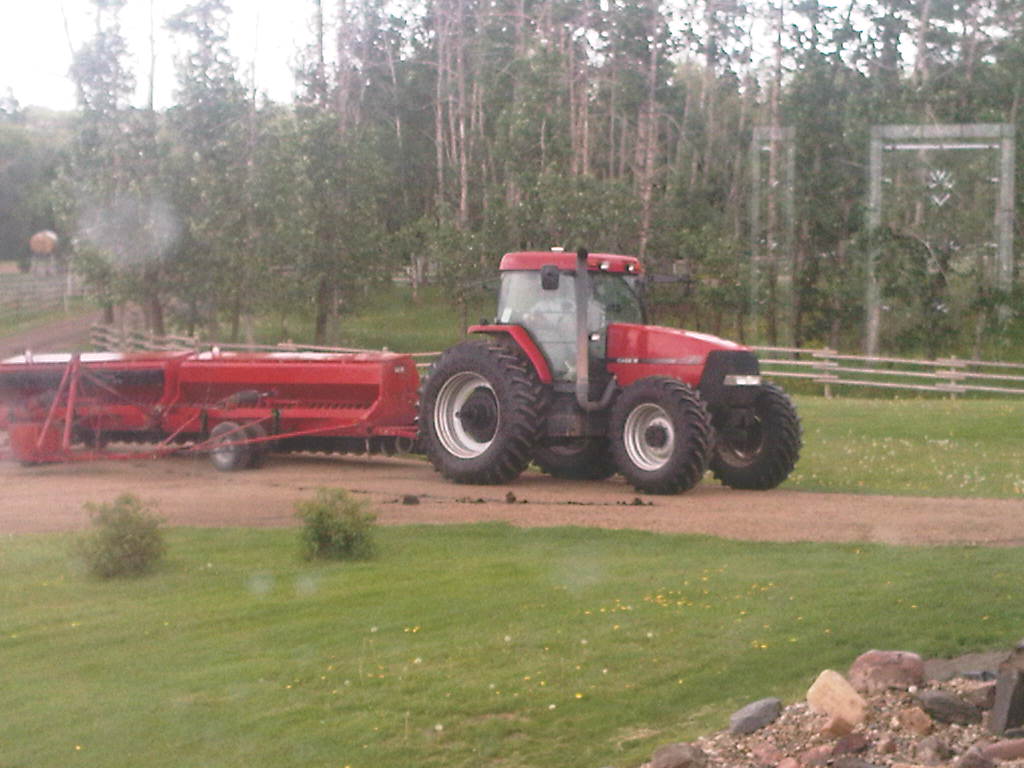
  • Seeding.  Seeding crops can get quite costly.  On our farm we still use the till method of seeding.  So we have to go over our land with the cultivator, the harrows, the drill, and then with spray and fertilizer.  That equals a great deal of fuel consumption.  And the seed and products aren't free either.  We have to buy the seed, the fertilizer, and the sprays to fight off weeds.  We then have to pay someone to spray the crops for us.  
    • To give you an example I will use barley.  This year we put in 400 acres of barley.  Seeding barley costs about $12/acre.  Multiply this by 400 acres, you're paying roughly $4800.00 to seed 400 acres of barley.  Fertilizer costs on the barley were roughly $50 an acre; 50X400= $20,000.  Since we don't do our own spraying, to spray our barley crops we are paying $30 dollars an acre, this includes the spray and the application; 30X400= $12,000.  So add the spray, the seed and the fertilizer, you're looking at $36, 800 to plant 400 acres of barley. This year we have acquired extra costs because of all of the rain.  Right after we seeded a few of our crops, it rained so much that the seeds started to rot.  So we had to re-seed part of our crops.  Then, if re-seeding wasn't enough, the rain washed the sprays from the fields and we had to redo some of the spraying also.  This means we had to pay for the spray and the man doing the spraying!
  • Pasture. As soon as the snow melts the cows head out to pasture.  This is a way easier time of the year for us as far as cattle go.  The bulls get put out with the cows, and the temperature is warm so the babies start growing rapidly.  This year we were fortunate enough to have rain and fantastic pastures, but a few years ago during the drought, we were forced to feed hay bales to cattle, adding just another extra cost, and putting us in a position where we needed to save all of our extra bales for winter.  On our farm we usually have a surplus of round hay bales and are able to sell some for income.  This works well when weather cooperates and we have a good hay season, but we can`t always count on this. 
  • Processing calves.  For our family processing calves involves giving cows and calves shots, branding, and castrating the calves.  
    • Castrating- On our farm we have the vet come out to castrate our calves.  This means that she has to cut every set of testicles out.  It`s a pretty rough job, and it isn't cheap.  Our vet charges us $4/calf, when you're doing 100 calves (differs every year), it can get pricey.
    • Shots- Before the cows disperse to their summer pastures we treat the calves with 8-Way shots and Live IBR.  The calves also get Ivomec.  We also treat some of the cows with Live IBR shots.
      • IBR- 100 mL bottle treats 50 calves for IBR.  It costs roughly $2/calf
      • 8-Way - 60 head can be treated with a 250mL bottle, costing roughly $0.50/calf.
      • Ivomec - 5L jug of Ivomec can treat 70 cows, or 400 - 500 calves.  A jug of Ivomec costs $90.
    • Branding- there aren't many costs associated with branding once you have the branding iron
Summer

The summer months for us are the least busy months.  Once the seeding is done and the cows are happy in their summer homes, we have time to do the odds and ends.  Of course we still have to check cows and crops.  The summer is also the season for Junior Cattle Shows! My sister and I are active in Junior shows, and have been for the past nine years.  There are entrance fees, travel fees and accommodation fees all associated with cattle shows, but I wouldn't give them up for the world.  Through summer shows I have made many friends, had countless opportunities and doors open for me, and have learned to do by doing.  Cattle shows helped me to find my passion for agriculture and helped me realize this is where I belong!  For the summer synergy show, I entered three yearling heifers; one Simmental, one Charolais, and one Red Angus.  My entrance fees were almost $200, not including accommodation, feed for the cattle, or travel expenses.  
Fall

Out of all of the seasons, fall is our money maker.
Fall brings our harvest and the steer calves get shipped to market.  
  • Calves.  My dad hauls our calves to the market at the beginning of October.  The calves are roughly 700-850 lbs by this time.  This week at the Rimbey Auction Mart, where we sell our cattle, 700-800 pound steers were selling for $1.25/pound! This is a great price!  That means that for an 800 lbs steer, we're making $1000! That is a super price, especially if we are selling 70 steers! However, that doesn't mean that we have a net income of $70,000.  But we don't sell our cattle in the summer, so likely by fall the prices will be a less.  There is also a National Check Off of a non-refundable $1.00 that comes off of the price of every animal, as well as a Provincial Check Off of a refundable $2.00 that can be returned if applied for.
    • Let me break down the cost of raising a steer to butcher size, say, 1300 lbs. 
    • If we were to fatten a steer for butcher, we would likely start the calf on feed in September when the calf was roughly 700 lbs.  The cost before the 700 lbs isn't very high, roughly $100/calf, if you count the calf feed, any medical bills and extras.  Once they hit 700 lbs, we send them to the auction mart.  If we wanted to fatten the calf starting in September, we would likely butcher it in April.  For example, with a 4-H steer, the calf is on feed for 212 days.  The estimated feed costs for this calf are $420 in those 212 days.  
    • There are also other costs:
      • Straw bedding- $50
      • Health Costs - $15
      • Sale costs - $50
    • Roughly $550 in deductions off of the sale price.  
    • So if we sold a 1300 lbs calf today we would make $1625 - $550 in deductions so roughly $1100, not that much of a profit when you consider all of the money that went into making the feed and raising the calf.
  • Harvest.  How much money we make all depends on how the weather treated us, and the yield of our crops that year.  Farming is one of those occupations where you never know how much you will make.  The prices of everything in the agriculture industry can change in an instant, for the better or the worse. This is what makes the industry somewhat challenging.  We cannot predict what the weather will bring, nor what the market prices will be, so we never really know what we will be making as income from the crops.  Interested in figuring out the daily grain and canola prices??? I know you are, you can find them HERE
  • Swath grazing.  Our family swath grazes our cattle which helps us to save on fuel costs and time spent feeding.  It also allows us to naturally fertilize our crop land by having our cattle roam on the sections
Winter

The cows need feed and bedding everyday.  We have to use heated water'rs to make sure that the cows always have water.  Electricity costs are higher, and the depreciation on the loader tractor, and all of the farm vehicles increases.  The cost of machinery is not cheap, so my father and grandfather always work hard to take good care of their equipment so that we can make it last as long as possible. 

So hopefully that summed it up a bit for you.  It would take way more than one blog post to explain all the costs to farming, and all of the aspects of it all, but I hope I was able to put a bit of it into perspective for you!

I found a really great database all about farming! The Farm Budget Database breaks information right down to type of farm and everything! It is awesome! 
Another awesome farming website is 24-7 Ag TV, there are a bunch of different videos all about agriculture and different aspects of the industry! I love the site, and I can promise you will learn something!

Thanks for reading! 

Friday, 20 May 2011

The Beef On Canadian Cattle

Did you know ...


  • as of July 1, 2010 there were               12.57 million beef cattle in Canada
  • 53% (26,500) of Alberta producers have beef cattle
  • Alberta cattle and calf numbers – 5.5 million head (40% of Canadian total)
  • Canada cattle and calves – 14 million head
  • Alberta has 1.95 million breeding beef cows and heifers (39% of Canadian total)
  • Alberta feeds over 2.18 million cattle each year with total annual beef production of over 773,000 tonnes
  • Alberta averages 189 beef cattle per farm
  • Alberta has 21,095,393 hectares of farmland - 
  • 31% of all Alberta farmland is natural land for pasture
  • 12% of all Alberta farmland is tame or seeded pasture land
  • Alberta federal and provincial inspected plants processed 2.4 million head of cattle or roughly 71% of the Canadian total in 2009
Alberta Cattle Industry Statistics - As found by the Alberta Beef Producers
  • In 2009 there were approx. 49,500 farms in Alberta
    • 53% had cattle
    • of the 53%, 41.5% were beef cattle farms
  • beef cattle provide 34% of Alberta total farm income
  • benefits the economy by over $11.6 billion
  • Alberta exports of beef and cattle are valued at approx. $1.4 billion annually
  • in 2009 beef was the largest meat export at 70%
  • in 2009 Alberta shipped 236,000 tonnes of beef, $708 million to the USA
    • live cattle exports at $465 million

For more Canadian beef info check out these links - 
Check out this link for a few videos! Explore Beef with the help of the Alberta Beef Producers!


Have a safe long weekend everyone! I will be at work, the entire weekend, please think of me! :)

Sam