Showing posts with label Animal Mommies. Show all posts

Monday, 13 June 2011

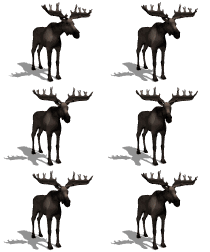
Moose on the Loose!

Yes! The title says it all!  There is a moose on the loose in Crestomere County!


Earlier this morning my grandfather was getting ready to go and inspect our crops.  Because of the large amount of rain after we seeded some of our barley, combined with the cold weather, the seeds rotted.  When the seeds rot, it means no crop for us, so my dad is hard at work this afternoon trying to re-seed the crops that were ruined by the weather.  This is just one of those everyday challenges that farmers face.  Re-seeding a patch of land means we have to pay for more seed, more fuel in the tractors, and we have to wait for an even later harvest.  Lucky for my dad and grandpa, our little Border Collie, Lady, loves the opportunity to ride in the tractor, so they always have company.

It is a little hard to see, but if you look close you can see the little black and white baby riding in the tractor with one of her two favorite men.  She's pretty much the cutest dog on earth.  For all those wondering, the piece of machinery hooked up to the tractor is called a drill, and we use it to seed our crops

Anyways, back to the moose.  My grandpa jumped in his truck and as he was driving towards the pasture he spotted what he thought was a large horse in the small pasture separating our houses.  Wrong.  That was no horse.


Fact: moose are the largest members of the deer family and they often stand taller than a large saddle horse (they don't compare to the heavy horses).
So.. When most people think of a moose they compare them to a horse.  BUT did you know that moose have cloven feet (a split down the front) just like a COW!! Horses on the other hand have hooves that do not have splits but are one piece.


Fact: A male moose is called a Bull Moose, and a female moose is called a Cow Moose.  It seems as though they are getting more and more like the cattle we farm, and less like horses as I once suspected.
Bull

Cow and calf

My grandpa was shocked to see the moose that close to buildings, just strolling around.  My grandma was so excited as she told me this story.  She had asked Grandpa if the moose had any antlers.  None that he had seen.  Grandma stated that it must be a girl then, if it didn't have antlers.  That isn't always true!

Fact: A moose begins growing antlers in spring or midsummer, and it isn't until the late summer and autumn that a mature bull carries its rack of antlers.  So, being that it is only mid June, the moose may not have started growing them yet.  Bull moose shed their antlers each winter, just to grow a new set in the spring.  Antlers and horns are two very different things.  Horns stay on an animal their entire life, like on a cow.  Antlers regrow each year, like on the moose, elk and deer!

Fact: Since the antlers are shed each year, the size of the antlers has nothing to do wiht the age of the animal, it does however have something to do with the health of the animal.  In order have to have great antlers the animal needs to have a large source of calcium to grow these antlers.  Where does this calcium come from when they have a strict diet of veggies?? Their own BONES, primarily their rib cage! So, these animals need to be pretty healthy to be able to afford to give so much calcium from their own bones!

Fact: When it is time for baby making, the bulls with the largest antlers usually get the hottest cows.  Of course they have to compete with other bulls.  All the competing eventually uses up energy and strength that the bulls have saved for the long winter which can sometimes cause them to be very rundown before winter and possibly mean death during the cold.  It is a sad ending for many of the handsome, big racked male moose, but at the time of mating, those bulls are getting the most tail!  The moose population is one population where saying "nice rack" is highly accepted!


Fact: Moose are ruminants just like our cattle! They spend much of their life chewing their cud.  For all those who don't know, ruminant means that their stomach is divided into four discrete sections, in other words, four different stomachs.  For a moose, their diet can often contain fibrous plants, as well as branches and leaves from trees.  Just like cows, moose regurgitate and rechew their food after it has spent sometime fermenting in one of their four stomachs.  So if you ever see a cow chewing while lying down with their eyes closed, that is a good sign that they are relaxed and enjoying the meal that they literally "saved for later".  With our show cows, we can always tell when they are calm when they start chewing their cud in the show ring, or while their tied up getting brushed.
The four parts of the ruminant stomach, a moose has this too!

 Fact: Moose can pretty well dwell in any terrain.  With their long, stilt-like legs, they are powerful swimmers and can easily walk across fallen trees.  They have large hoobes which help them to wade through snow, and the spongy muskeg on which they love grabbing a bite.  You would think that with their large size and big antlers (spanning anywhere from 120-150 cm) that they would make a great deal of noise walking through trees, crashing into things and such.  However, they are well adapted to pretty well any surrounding and are silent as they move through the trees.  I have enough problems sneaking up on people with size 3 feet, and a small mass of 120 pounds, I can't imagine weighing over 1000 pounds, with a huge set of antlers, and large feet, and still being able to silently move somewhere.

File:Alces alces NA.svg
This caption shows where four different types of moose live  in North America.  These four breeds have a pretty good span of the continent! 
Fact: Moose are great swimmers.  Just another one of those qualities that I didn't see coming.  And to make it even more crazy, they can hold their breath for up to a minute under water.  Imagine canon balling into a river or lake that you assumed was empty, and then ten seconds later when you surface to see a big set of antlers paddling beside you.  I think I may have a heart attack.  The video below show two baby moose swimming while their mother enjoys a snack from the bottom of the lake! Super cute!  


This isn't the first time that we have had interesting wildlife on our farm!  Since I have been alive we have had badgers, a cougar by the barn and a black bear in the pasture, as well as countless deer, coyotes, foxes, and the friendly old beavers and porcupines!
Beavers live in North America. Continents features the continents from space, maps of continents, animal locations, geography facts, and endangered species news.

To finish off this moose extravaganza, I found probably the cutest video of all time! Twin baby moose running through a sprinkler! I wish this is what had happened on our farm today!


References:
http://www.northcountrynewsnh.com/web_pages_000017.htm
http://www.mountainnature.com/articles/antlers.htm
http://www.canadiangeographic.ca/kids/animal-facts/moose.asp
http://www.google.ca/images

Sunday, 8 May 2011

Mommy Mayhem

Today is a day to celebrate mommys everywhere.  And that is exactly what I did.  I woke up early this morning so that I could write a nice card for my mom, just a small way of letting her know just how much she means to me.  I won't get onto a long explanation of just how fantastic my mother is, because it would take me a lifetime to explain it, and I have much to say in this blog.  All you need to know, is that I have the best mother in the world, as I am sure many of you would say about your own mothers.  My mother is amazing, she works so hard to give my family the best life ever, and she always tries her very hardest to help others out.  She's genuine and sweet.  I love my mama. 


Now onto the other mamas.


I woke up early this morning to head to the Ponoka Community Golf Course where I spent the morning serving numerous moms at the special Mother's Day Brunch.  It was so nice to see so many families out with their mothers, happy and thankful for what they do.  I think that is what should happen.  Quite often, especially in the case of my mom, mothers spend 364 days of the year putting their kids first and running around after their kids, today should be to honor them, even though I know they deserve so much more. 


When I finished my shift of serving tons of mommy's, I was greeted at home by both of my Grandma's, my aunt and her family, and my mom.  It was so awesome to be able to honor all the important moms in my life, all in the same place.  I love family time more than anything in this world.


But enough about my mommys, I have so many more for you to meet, and many more that we need to honor.


First come the cow mamas.  On our farm we have roughly 200 mommy cows that we calve out each year, starting in late February and usually going to the end of May. (Note: when I say "calve out" I mean we breed 200 cows so they then have their babies on the farm.  A cow giving birth is called calving, so when we talk about calving and our number of cows we say "calve out").  Today we had to honor 200 mommy cows as well.  When talking about cattle, the mother is called a cow, the father a bull, and the baby a calf.  But it doesn't stop there!!! Female and male calves have different names too!  A female calf is called a heifer, and this name stays with them until they have their first baby.  A male calf is born as a bull, however, you have probably often heard the term "steer".  A steer is a bull calf that has been castrated (aka lost his manly parts, or testicles).  If you want to know why we castrate calves check out the "All Things Agriculutre" tab tomorrow, and I will feature a story on why we do what we do, I can promise it will be nutty...  On our farm all of our male calves become steers, and I will explain why that is in the story so check it out!
Mommy cows usually spend most of their career making babies... well actually, that is their career.  The minute they stop making babies they usually get sent to the auction mart.  On our farm the cows usually spend roughly 9 months being pregnant, and they usually have their first calf when they are 24 months of age.  After calving the calves are most dependent on their moms from birth to about three months old, for beef cows that is.  Dairy calves are usually taken away from their mamas at a day or two old.  Poor babies.  We usually wean our calves (separate them from their moms) in eary October, when they are anywhere from 180 - 210 days old, 6-8 months.  By the time that the calves are weaned the mama cows are already bred again.  Mama cows usually get bred two to three months after they calve! 


So now that you know all about the cattle, and the mommy cows it is time to introduce you to more mommys on our farm!


Dutch and Dixie - Our German Shepards
Dutch is our oldest dog on the farm and at 12 years old she has had two batches of puppies, Dixie being one of her babies.  Dutchie was a good mama, and she loved having babies so much that one spring she stole a couple of baby kittens from the barn and put them in her dog house to stay with her!  Dixie was also a mommy on our farm, and although her puppies were all given away, she was still a good mommy!  
A mother dog is called a bitch (not meaning to swear, unfortunate title really) and a father is called a dog.  The babies are called pups, and boy are they cute!
Dogs have a gestation of 9 weeks, approximately 63 days, and the pups rely on their mother the most during the first three weeks.  At 7-14 days their eyes open and they begin becoming more independent.  Puppies can be weaned from their mothers between 3 to 8 weeks after birth. 
The puppy is Tucker, he is Dixie's baby, and Dutch's grandson.  Dixie is the dark brown German Shepard lying on the grass, Dutch is the lighter German Shepard sitting up, and Lady is the Border Collie, the dog who thinks she is human.  The father is the neighbors dog, we would never say it to their face, but the puppies were an accident.

 The cool thing about mother dogs is that the same litter of puppies can have different fathers!  Female dogs are capable to conceive each time that they get mated!  Half of the litter can look like one dad and the other half the other dad!  Try explaining that one to the husband, hunny I swear some of the babies are yours!
These three puppies were out of the same litter, all belonging to Dixie.  This shows you that yes indeed puppies can have different dads and still be born in the same litter.  Zoe and Tucker were born with short tails, short hair, and Mia had long hair, and a long tail! Crazy!
And now for the kitties!
It seems as though every year our cats are the most active mommys around the farm.  The cats teach their babies all about being independent and fending for themselves, cats don't really need to rely on humans, domesticated or not.  A male cat is called a Tom cat, and a female a Queen.  The babies of course are kittens, and I can honestly say baby kitties are one of the cutest baby animals in the world!  Mother cats spend 63-65 days in gestation, and the babies are usually weaned by five weeks of age.  Just like puppies, the kittens are born with their eyes closed, and their eyes open between 5 and 8 days.  Kittens were the light of my life when I was little, "kitty" was my first real word!  I used to spend hours in our hayloft every minute I was home in the hayloft playing with the baby kitties and watching them attack one another and play all day and then curl up with the other kittens for a snooze.  A big bonus to living on the farm is being able to have baby kittens every year and then picking from the litters the two or three that I want to keep before we give them away to the neighborhood farms!


Ducks!
A male duck is called a Drake, a female is called a Duck, and the babies are called Ducklings.  A few years ago a wild duck made a small nest under a spruce tree in my grandma's yard.  If we ever went out there we could see her out there tending to her eggs.  Watching baby ducks follow their mama around is such a site to see!  The duck has to worry about so many little babies at once, and Jon and Kate thought they had it bad!  Just watch the video I posted in my blog a few days ago, and you can see the determination of the mother duck while she gathers up her babies that have been swept away in the wind!  


After a duck lays her eggs she usually spends about 23-28 days sitting on them before they hatch!And then the cute ducklings appear and can stay with their mother their entire life in the flock, but usually are done relying on their mother at 12 weeks.


Chickens!
A male chicken is called a rooster, and many people wake up with him.  A female is a hen, and a baby is a chick.  Chicks are often raised in incubators (a warm lamp used in place of a hen) and are raised away from their mothers when on farms.  Hens normally sit on their eggs for 20 -22 days.  If you have ever had the chance to hold a chick, or touched a chick, you will know that they are one of the softest baby animals ever!  Their little feathers are like silk, and they are cute little balls of fluff!


Pigs!
Piglets are the babies.  Another one of the cutest baby animals in the world... If you're sensing a trend, yes, I do believe that every baby animal is the cutest in the world.  It just depends which animal I am seeing at the time.  A mother pig is called a sow, and a father a boar.  Some animals stay cute as they age, I tend to feel that pigs are not one of those animals, they lose the cute.  A pig has a gestation period of 112-115 days and the babies can usually be weaned from 14 to 28 days old.  Mama pigs can have anywhere between 8 and 14 babies, imagine looking after that litter, that mama's house must be a pig sty... :)    


There are many more animals out there that I would love to talk about and inform you of, but I am just a little out of time and don't know how much more you can handle reading, so if you have a question I would love to check it out for you and write you a story about it!!


I hope you enjoyed the special "Mommy Mayhem" edition, now enjoy the rest of your day with your mommys!!


<3 Sam