. Country girl . Farmer's Daughter . Charolais, Red Angus, Simmental cattle . Faith in God . Bachelor of Science Student . Volunteer . Cattlemen's Young Leader . Five Nation's Beef Alliance Member . Border Collies . German Shepards . Cattle Shows . 4-H . Lacrosse . My Passion . My Life . My Future .
If any of you have grown up spending a great deal of time with your fun and crazy grandfathers, I am sure that you have heard the comment "Chocolate milk comes from brown cows, didn't you know?".
My grandfather was, and still is, a man of jokes and teasing. When my cousins were small he would tell them that the chicken we were eating was actually rabbit, and that he was allergic to tomatoes so he was the only one that didn't have to eat them (as he drenched his other food in ketchup).
He is famous for teasing us and I realized that for some people the idea of brown cows making brown milk and brown chickens producing brown eggs could be very valid.
I dug deeper into these two myths to see just what the facts were.
Myth- Brown eggs are healthier than white eggs!
Just like a human baby, chicken babies share genes with their parents. These genes are what determine the color of the shell. The shell color is dependent on the breed of the hen. Therefore, the color of the shell has nothing to do with the nutritive quality of the egg itself.
There is a large variety of chicken breeds as well as egg types. Click on the link to see a full list of Chicken and Eggs.
When it comes to white and brown eggs, there is no difference in the nutritive value, flavor or the cooking performance between the two types of eggs!!
Did you know:
eggs can absorb flavors from your fridge because they have many pores, that's why it is good to keep them in their carton to keep them fresh!
eggs are high in protein, so high that a mother's breast milk is the only source of protein higher in quality! Eggs contain 14 essential nutrients and all nine of the essential amino acids - essential meaning the amino acids that our bodies cannot produce!
hens lay approximately 300 eggs per year!
eggs are supposed to increase energy, and improve eyesight and memory!
good for brain development and weight management!
and for the students of the world, eggs are affordable and quick to cook!! That's my selling point!
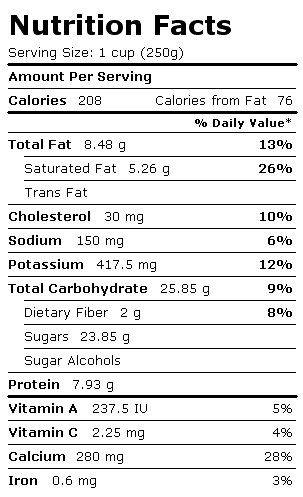
Myth - Brown Cows Produce Chocolate Milk
If you don't honestly know the answer to this myth, it is false.
All cows produce white milk, regardless of breed or type, dairy cow or beef cow!
The only difference in milk from different cows is quality or quantity, not color.
Chocolate milk is made from sugars and coca beans!
Milk is great for our bodies and minds. The high levels of calcium help us to maintain strong bones, while at the same time providing us with energy and 15 essential nutrients!
With six years of school left, I am working hard to make some money to save up this summer which has resulted in me getting two jobs, both at local golf courses. Being a waitress gives me a great way to connect with many different people on a daily basis. I often find conversations eventually leading to the fact that I live on a farm.
The other day, a girl asked me if we milked our cows, and I responded "no, we have beef cattle on our farm" assuming that would be enough of a response. However, the girl just looked at me and said "So what is the difference from a milk cow to a beef cow, can't you use them all for everything?"
It seems so obvious to me why we would use certain types of cattle for milk and certain for beef, but I guess not being raised around farmers, and on a farm, I might not really have a reason to know.
So I began to explain to her the difference between milking cows and beef cows.
First of all there are two common divisions of cows, with many subdivisions. In one corner we have the "beef" cows, the cows that we use for meat and human consumption. In the other corner we have "milk" cows, the cows that are raised to make milk, cream and dairy products.
The "Beef" Category
In the "Beef" category, you can break the category into many different breeds! With over 800 different breeds of cattle identified in the world, it is no wonder that there is confusion when talking about cattle!
Below are some of the most common breeds in North America!
Beef cows are raised primarily for the purpose of meat for human consumption. Females are kept on farms to produce calves, and often it is the male calves and lower performing female calves that are sent to be made into beef.
Beef cows are not usually used for milk and once their calves are weaned they dry up, usually only producing milk for 6-8 months out of the year, less than the ten months of the dairy cow. If you wanted to milk a beef cow you could, however, they have generally smaller udders because they are not bred as much for udder structure and milk production as the dairy cows are.
On our farm we have to milk our cows sometimes when a calf is sick and can't eat on its own. When this is the case, we do our milking by hand and then tube feed the baby calf to make sure that it is getting the right amount of nutrients to try and nurse it back to health.
Trying out some Beef milk, right from the cow!
The "Dairy" Side
In the "Dairy" category, there are 11 breeds that are most commonly found in North America, with approximately 40 common breeds across the world. I wanted to know just what the breeds were like, so I did some research! Below I have included pictures of all of the common dairy cattle in North America, as well as a link. This link will take you to a site which has pictures, news, information and history about each specific breed. If you want to learn more about one of the breeds just click the name of the breed below the picture and it will take you to that breeds information!
In Canada, the Holestein breed is the most common breed, with over 90% of dairy cattle being Holstein
Typically, when one thinks of a dairy cow, we get the image of a skinny black and white cow, with a large udder and a well defined topline (spine), well this is what image comes to my mind at least! In reality, there are actually a diversity of color and shape of dairy cows, all with the same quality of being able to produce large amounts of good quality milk.
Dairy cows are not usually used for meat because they are generally much skinnier than beef cows, lacking the muscling, fat and finish that you see on most beef cows. A good beef cow is one that is well conditioned (quite fat), and a good dairy cow is usually one that is quite slender, not much fat on their body.
On the average North American Dairy farm, the cows are milked twice daily, with roughly 12 hours of rest time in between. This means that Dairy farmers are getting up anywhere from 4-6 AM to milk the cows, so that they can finish them that night between 4 and 6! That's early! If the cows are not milked within the 12 hours, their udders often get too full and they can start to become uncomfortable for the cow. If you stop milking a cow completely, she will dry up and will not produce milk anymore until she has another calf. After having a calf, the cows are usually milked for 10 months before they are dried up and about to calve again. The cows are always bred at different times so that they calve on different days all year round.
A good friend of mine has a dairy farm and her family always has baby calves running around. They have their operation set up so that they are always milking roughy 200 cows, with about 30-40 dry cows that are about to calve. This way they are always milking the same amount. On their farm they artificially inseminate all of their cattle (meaning they don't use a bull to breed the cows, they inject the sperm on their own). This allows them to choose what day the cows are bred and gives them an idea of the exact day that each cow will calve. Lucky for me, they live close to our farm and were able to AI my little Charolais heifer for me this year, hopefully they used the right straw of semen and I won't be having a tiny Holstein showing up next spring!
So what about the babies!
On a beef farm the calves are kept on their mama's until they are weaned at roughly 6-8 months. This means that the babies rely on their mamas for milk for every meal.
In comparison, on a dairy farm, the calves do not spend their lives relying on their moms. Dairy calves are taken away from their moms shortly after birth and rely on the farmer to feed them. The farmers use the milk that they milk from the dairy cows, so the calves are still getting mother cow's milk, they are just not getting it directly from the cow herself. Up to two or three months old the babies are kept in individual little houses where they are given special attention, personal milk and food. When they are a bit older they are moved to group pens, where they are still given milk in troughs, just not individually anymore.
If you have questions on dairy cattle, check out this link, it has a bunch of questions with answers, from where the milk goes to the age of cows, all things that take place on a dairy farm are covered in these answers so check it out! I learned a great deal even though I knew a fair amount of knowledge about dairy farms! Dairy Farm Questions Answered


 Just like a human baby, chicken babies share genes with their parents. These genes are what determine the color of the shell. The shell color is dependent on the breed of the hen. Therefore, the color of the shell has nothing to do with the nutritive quality of the egg itself.