Showing posts with label Farming. Show all posts

Tuesday, 14 June 2011

No Place For a Cat

With my birthday at the end of the week, I had to think long and hard about what I wanted! This is the question that I always dread.  I get nervous and try to ignore the question altogether.
Or else I throw out random, unrealistic things, such as a hotel (Paris Hilton style), a new car, five cows, or a trip around the world.  Of course, these things rarely happened.  I guess the car really wasn`t that ridiculous as my parents got me my sporty Honda Civic for my 16 birthday.  Have fun topping that one up mom and dad.
This year I really don`t know what to say to people when they ask.  I want everything and nothing.  I am so happy with all the lovely things that my parents give me that I don`t really need anything else.  My life is pretty much perfect.  I have two jobs which help me pay for school, and my parents and grandparents always have my back when it comes to life.  I have an awesome family, fantastic friends, and I live on a great farm.  What more could I really ask for?
And then it clicked.  For the past two years our cat population seems to be dwindling.  Growing up I had a slight obsession with cats.
And by slight, I mean huge.
First of all, "kitty" was my first word.  In our old house, our hallway window was at a low enough level that I could stand and look out into the yard.  My mom said that I would stand there for hours and watch the kittens play.  As I got older I was always surrounded by cats.  I spent every waking moment that I wasn't at school or sports outside with my animals.

In grade 3 one of our barn cats had a small orange kitten.  I made it my habit to name all of the cats on our farm, even the year that we had a total of 40 at one point (I guess that's what happens when you have 7 mama cats).  Thankfully, that year no one else in our community had kittens and everyone wanted some.
But back to the orange cat.  She pretty much had the most original name, Baby Orangie.  I know.  It's like calling the black cat Blackie.  Anyways, this cat was my baby.  I could do anything with her.  I would go to my grandparents every day after school and play with her.  My grandma would let me sneak the cat into her house.  I had a small shoe box with blankets in it for her.  She would lie in her bed and let me brush her, dress her up, pretty much do anything.
Grandpa didn't like animals in the house, so whenever he would come in one door, Orangie would go out the other.
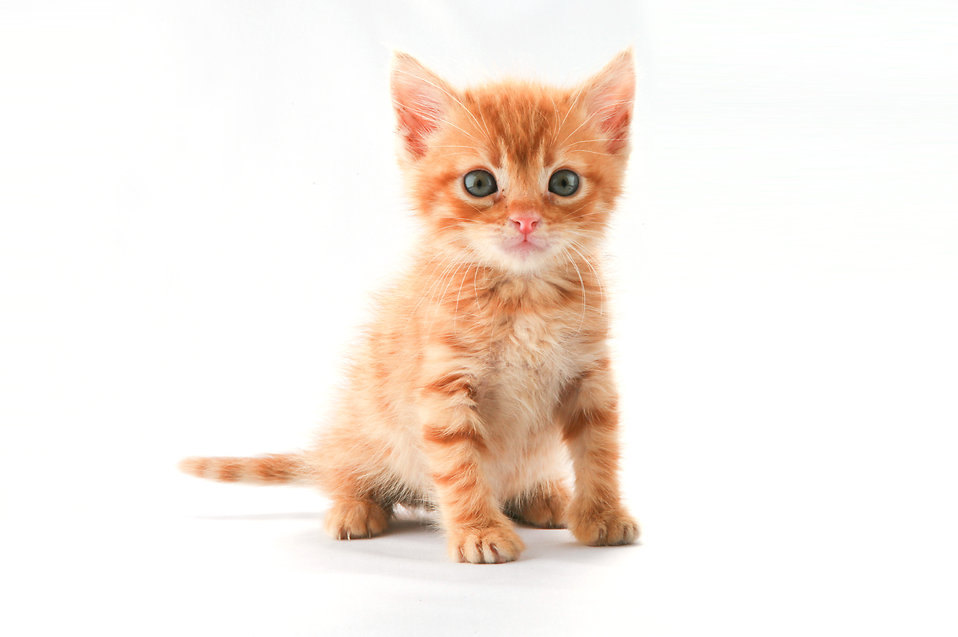
Orangie even accompanied me to our small, country schools on a few occasions.  All you city folk, beat that show and tell surprise!  When you go to a small school with 14 kids in your grade you get anything from dogs to frogs in your class for show and tell.

I would spend countless hours in our hay loft with the kittens.  I did everything from giving kittens eye drops, to teaching the little babies how to drink from a dish.  Note - when I say "teach them how to drink from a dish" I didn't literally lean over the dish and start lapping up milk! I would dip their little noses in the warm milk.  They would then lick their little faces and realize how yummy the milk was! This would start them on their way to weaning from their mamas!
My handsome little man
All my kittens would have names.  And I would remember them.  Yes, I was obsessed, I admitted it already.
One morning before school I was in the barn feeding the cats and I could hear meowing, kittens.  I climbed into the hay loft, couldn't see them.  Back down into the main part, couldn't find them.  The noise was coming from the wall.  The kittens had climbed into the lean-to part of the hayloft and fallen into the wall!
Our barn is quite old, and the walls were hollow.  The kittens were stranded! I didn't even know what to do.  I tried thinking of ways to save them, and I realized there was no way I was getting them out.  I didn't want them to have to die.  I love my animals, and the minute they get a name they become that much more special.
I started crying. What else was there to do? My babies were going to die.  Once again, Grandpa came to the rescue and diligently got to work taking the boards off of the wall, saving the babies.
funny kitten pictures. Cats!
I have so many more kitten stories that I could share, but I am afraid my blog would be chapters.

So I decided I wanted a couple of kittens for my birthday.  But they couldn't be just any kittens, I wanted to pick them out.  So I started looking around Kijiji and I found exactly what I was looking for.
"Sweet Rescue Kittens For Adoption, Apply Now"
Why not adopt from a shelter! Help them out since they help out all the homeless and neglected kittens.  What better a life for a cat than to live on a farm where they get milk and cat food each day, a warm barn and heated shop to sleep in, a huge place to run outside, a family that loves them and mice!
So I clicked the link and my heart melted when I saw Bella.

Bella, only a month old, needing a family. 
I wanted her.  Who wouldn't! I wanted to be her mommy, and cuddle her and care for her!
So I clicked on her link and it took me to a website called SAFE - Saving Animals From Euthanasia.  Perfect, I would love to help these people out.
I can't find a number so I click the link that says "fill out an application".  Seriously?  I never made people fill out applications when they had our kittens.  Now I am worried, did my kittens go to unloving families.
On the application there are questions that say things such as what type of home do you have, will the cat be inside or outside, have you had a pet before, why do you not have you previous pet, have you ever been charged for an animal crime, will the animal be spayed, and the one that surprised me will you allow our team a minimum of three follow up visits to see your pet.
Wow.  I feel like I didn't give my kittens a chance for survival! I didn't do follow up visits.
So I filled out the form.  I said that I loved animals and that I wanted a kitten to live in our shop, who could have free range of the shop, barn and farm.  What a better life for a cat! Grow up with a family that loves you and cares for you, with two other kittens your own age, and a huge farm to play on, as well as a great opportunity for health care and warm meals every day! Is there a better life for a cat?  Some people in this province aren't even guaranteed all those things.
So I sent in the form.  By this time I was super excited.  I couldn't wait to get my new kittens!
My email flashed. A response!
I was so excited.  Best birthday ever!

I opened...

I read quickly...

The smile faded from my face.

"Thank you for taking the time to fill out an adoption application which we have reviewed and declined."


Declined!!!

How was the best life for a cat ever declined!

Apparently, they only want the adopted cats going to places where they will only be indoors and have a lifelong companion! I wanted to be a lifelong companion!

I had put on the sheet that I didn't want my kitten spayed, I wanted it to have a set of babies so that we would be able to have enough cats once again to control our farm mice.

Wrong answer.

Apparently they only give their cats to people who are going to spay them.  They said that there are too many homeless cats in the city that need homes so they are trying to control that by spaying all the cats.  I do understand why they make that a rule, especially in the city, and it is a good idea, but the farm is a different situation!

Well, on our farm, and in our farming community, we need cats.  It isn't us with the problem! I completely understand where they are going with the whole spaying thing, and I would have got them spayed if that was a requirement!

But apparently the farm is no place for a cat.


They said that Bella has never been outside and would likely end up being owl or coyote bait being out on a farm.

Seriously.  Before cats were domesticated they only lived outside.  And our German Shepard barks all night long, it's not like the coyotes sleep in the hayloft with the cats.  I wasn't just going to take her down to our bush and put her in an episode of "Cattracker" featuring a coyote.

I honestly felt somewhat offended.  I responded to the e-mail.  They say that they are having a problem with the cat population in the city.  I suggested to them that if they gave rural families a chance at adoption, they might be able to more easily find their cats good homes.  I told them that the animals on our farm are cared for like they're are part of the family, given a proper diet, love and affection, and medical attention.

A farm is no place for cats.  It seems somewhat hypocritical.
These cats look pretty happy to me. (this was a couple years ago when my cats were everywhere)

Fact:  Cats love mice.
Fact:  Cats are predators, they love hunting, and pouncing on things.
Newsflash: Cats like being outside too!

I'm heartbroken.
Tell me a kitten wouldn't be my companion!

Time to find a new kitty.  Any ideas anyone??

Sam

Monday, 13 June 2011

Moose on the Loose!

Yes! The title says it all!  There is a moose on the loose in Crestomere County!


Earlier this morning my grandfather was getting ready to go and inspect our crops.  Because of the large amount of rain after we seeded some of our barley, combined with the cold weather, the seeds rotted.  When the seeds rot, it means no crop for us, so my dad is hard at work this afternoon trying to re-seed the crops that were ruined by the weather.  This is just one of those everyday challenges that farmers face.  Re-seeding a patch of land means we have to pay for more seed, more fuel in the tractors, and we have to wait for an even later harvest.  Lucky for my dad and grandpa, our little Border Collie, Lady, loves the opportunity to ride in the tractor, so they always have company.

It is a little hard to see, but if you look close you can see the little black and white baby riding in the tractor with one of her two favorite men.  She's pretty much the cutest dog on earth.  For all those wondering, the piece of machinery hooked up to the tractor is called a drill, and we use it to seed our crops

Anyways, back to the moose.  My grandpa jumped in his truck and as he was driving towards the pasture he spotted what he thought was a large horse in the small pasture separating our houses.  Wrong.  That was no horse.


Fact: moose are the largest members of the deer family and they often stand taller than a large saddle horse (they don't compare to the heavy horses).
So.. When most people think of a moose they compare them to a horse.  BUT did you know that moose have cloven feet (a split down the front) just like a COW!! Horses on the other hand have hooves that do not have splits but are one piece.


Fact: A male moose is called a Bull Moose, and a female moose is called a Cow Moose.  It seems as though they are getting more and more like the cattle we farm, and less like horses as I once suspected.
Bull

Cow and calf

My grandpa was shocked to see the moose that close to buildings, just strolling around.  My grandma was so excited as she told me this story.  She had asked Grandpa if the moose had any antlers.  None that he had seen.  Grandma stated that it must be a girl then, if it didn't have antlers.  That isn't always true!

Fact: A moose begins growing antlers in spring or midsummer, and it isn't until the late summer and autumn that a mature bull carries its rack of antlers.  So, being that it is only mid June, the moose may not have started growing them yet.  Bull moose shed their antlers each winter, just to grow a new set in the spring.  Antlers and horns are two very different things.  Horns stay on an animal their entire life, like on a cow.  Antlers regrow each year, like on the moose, elk and deer!

Fact: Since the antlers are shed each year, the size of the antlers has nothing to do wiht the age of the animal, it does however have something to do with the health of the animal.  In order have to have great antlers the animal needs to have a large source of calcium to grow these antlers.  Where does this calcium come from when they have a strict diet of veggies?? Their own BONES, primarily their rib cage! So, these animals need to be pretty healthy to be able to afford to give so much calcium from their own bones!

Fact: When it is time for baby making, the bulls with the largest antlers usually get the hottest cows.  Of course they have to compete with other bulls.  All the competing eventually uses up energy and strength that the bulls have saved for the long winter which can sometimes cause them to be very rundown before winter and possibly mean death during the cold.  It is a sad ending for many of the handsome, big racked male moose, but at the time of mating, those bulls are getting the most tail!  The moose population is one population where saying "nice rack" is highly accepted!


Fact: Moose are ruminants just like our cattle! They spend much of their life chewing their cud.  For all those who don't know, ruminant means that their stomach is divided into four discrete sections, in other words, four different stomachs.  For a moose, their diet can often contain fibrous plants, as well as branches and leaves from trees.  Just like cows, moose regurgitate and rechew their food after it has spent sometime fermenting in one of their four stomachs.  So if you ever see a cow chewing while lying down with their eyes closed, that is a good sign that they are relaxed and enjoying the meal that they literally "saved for later".  With our show cows, we can always tell when they are calm when they start chewing their cud in the show ring, or while their tied up getting brushed.
The four parts of the ruminant stomach, a moose has this too!

 Fact: Moose can pretty well dwell in any terrain.  With their long, stilt-like legs, they are powerful swimmers and can easily walk across fallen trees.  They have large hoobes which help them to wade through snow, and the spongy muskeg on which they love grabbing a bite.  You would think that with their large size and big antlers (spanning anywhere from 120-150 cm) that they would make a great deal of noise walking through trees, crashing into things and such.  However, they are well adapted to pretty well any surrounding and are silent as they move through the trees.  I have enough problems sneaking up on people with size 3 feet, and a small mass of 120 pounds, I can't imagine weighing over 1000 pounds, with a huge set of antlers, and large feet, and still being able to silently move somewhere.

File:Alces alces NA.svg
This caption shows where four different types of moose live  in North America.  These four breeds have a pretty good span of the continent! 
Fact: Moose are great swimmers.  Just another one of those qualities that I didn't see coming.  And to make it even more crazy, they can hold their breath for up to a minute under water.  Imagine canon balling into a river or lake that you assumed was empty, and then ten seconds later when you surface to see a big set of antlers paddling beside you.  I think I may have a heart attack.  The video below show two baby moose swimming while their mother enjoys a snack from the bottom of the lake! Super cute!  


This isn't the first time that we have had interesting wildlife on our farm!  Since I have been alive we have had badgers, a cougar by the barn and a black bear in the pasture, as well as countless deer, coyotes, foxes, and the friendly old beavers and porcupines!
Beavers live in North America. Continents features the continents from space, maps of continents, animal locations, geography facts, and endangered species news.

To finish off this moose extravaganza, I found probably the cutest video of all time! Twin baby moose running through a sprinkler! I wish this is what had happened on our farm today!


References:
http://www.northcountrynewsnh.com/web_pages_000017.htm
http://www.mountainnature.com/articles/antlers.htm
http://www.canadiangeographic.ca/kids/animal-facts/moose.asp
http://www.google.ca/images

Thursday, 9 June 2011

Vacation Destination

I am sure all of you know someone, or maybe you are that someone, who has a home away from home.  Maybe it is a beach house that your family goes to for the summer, a hunting cabin up North, or a condo in the States where you spend the winter.  Regardless of who it is that you know, you get the point.

I know of a few couples who spend their winter in their RV, travelling the States.  Just like the geese, these couples fly South for the winter.  Seems pretty reasonable and straight forward, and I am sure all of you knew this.  But what some of you may not have known is this: on our farm our cows have a winter home too!


Yes, you read right!  Every year when the snow comes, my family starts preparing our North pasture just behind our barn for our cattle! This is the one time of the year when all of the cows are together in the same pasture, no bulls allowed!

In the summer, this winter home is seeded to crops.  Since I can remember, the cow's winter home has served as a grain crop, a canola crop, and this year a hay field! Lucky for us, having our cows out there for part of the winter means we have the best, natural soil enhancer!

So, why do we move our cows??

On our farm, our cows usually begin calving (having babies) around the beginning of March.  This means that by the end of February my dad has to start checking the cows every few hours make sure none of them have problems while trying to calve.  As you all know, tempratures in this province can be fairly drastic, so we don't want a cow to have a wet little baby outside in the freezing cold temperatures for too long, we want to make sure we are there shortly after the babies birth to bring it into the cozy barn, or to help the mother calve if need be.

So at the end of February we move all of our calves to a maternity pasture, nice and close to the barn! This is their vacation home
Just a few of the cows out on swath grazing a month or so before they got moved to the maternity pasture!

One of our biggest concerns during calving season is keeping those babies healthy!

On really cold nights if a calf isn't brought into the barn and warmed up on time bad things can happen...


The mama cow on the left froze her ears off when she was a baby! Notice how they are smaller than the cow on the right.

The baby could lose it's ears! When the little wet ears are left out in the cold for too long, they can freeze the tips off and leave the baby looking like this one!  The calf is still just as good as any other calf, they just tend to look like little goats!

Or the babies could get sick.  For sick babies we usually put them under one of our heat lamps, in a special little room just big enough for the babies.

And worst case scenario, a baby could die.

So we make sure that we are always out in the field, checking the cows every couple of hours.  My dad and grandpa are really good at being able to tell a couple hours before when a cow is going to calve.
Usually the cow will:

  • head off to a secluded area of the pasture by herself.  A few years ago my dad got lazy and didn't close the gate when going on hi bihourly check.  This is usually not an issue, none of the cows ever think to leave their winter home.  As an exception to this rule, my cow decided she wanted to go back to her summer home to give birth.  So she snuck out of the pasture and headed across the highway where we keep one of our groups during the summer.  Luckily for my dad, he could easily see her tracks in the fresh snow and found her in no time at all.  Luckily for me, the highway wasn't busy that night! Needless to say, my dad never leaves a gate open anymore, unless our Border Collie, Lady, is around to watch over it.  
  • the cows udder will have gone through a noticeable change in the week before they are about to calve. The udder begins to "spring" meaning, it tightens up with milk in preparation for the baby. 
  • The cow will have a water bag, a whitish sac filled with fluid that will break when the calf begins to tell. If the bag has broken, there is usually a string of it hanging down, and there will likely be wet parts on the cows legs!  
  • Be hunched up in her back,  with her tail up, or pointed straight outwards, looking like she is pushing.
  • Eventually, in most cases, the cow will lie down on her side and push the baby out.  When the baby finally does come out, the cow immediately starts tending to her young, and within a few hours the baby will be standing up, taking it's first drink of colostrum - a special, nutrient rich milk that helps to give the babies antibodies that they need. On our farm we milk some of our better milk producing cows so that we have some extra colostrum to give a baby calf if need be.  We store this in our freezer in icecream pails.  I can remember a few years ago, a friend going to grab our ice cream for dessert, opening the pail and saying "I think this ice cream may be bad, it looks pretty yellow".  Thankfully for her she didn't take a taste test, I don't think colostrum tastes very good!
After the cows have their calves, they get moved from the big calving pen, to a smaller pen where their mama's get put on a higher cut of hay (higher quality) and some grain for a few days while they adjust to their new babies.  This also alows us to keep a close watch on the new babies in case anyone isn't eating properly, or gets sick.  It is in these small pens that the babies begin to socialize with one another! Watch my little twins as they chase one another around! (sorry for the bad quality, I always snap pictures and videos from my phone when the babies are doing something cute, I don't always have my camera!)
  

After a few days in the new baby pen, the calves are moved out to their summer pasture.  Unfortunately by this time, there is still a great deal of snow on the ground so we have to feed them silage each day or spread out a bale of hay for them! 
In this picture, almost all of the snow is gone, but the grass just isn't  good enough yet so my dad still had to feed the cows a little bit! This picture was taken at the end of April!
Once enough of the cows have calved, we begin dividing them up by breed, and they get taken off to seperate pastures.  On our farm, all of the heifers get bred to a Red Angus bull, because they are known for their smaller sized calves, which means hopefully more ease when calving for their first time.  Our red cows usually go with a Charolais (white) bull, and the tans and whites go with our Red Angus or Simmental bulls.  We breed for tan or lighter colored calves, and with this method of breeding we usually get them!  We can't always sort the cattle like this though because you don't want a cow to be bred by her father! 


Here are a few of my dad's cows this afternoon, relaxing in the sunshine.  The red white faced cow lying down is my cow Sophie!
Isn't it amazing! The birds chirping in the background, the green grass, and the happy cows!

Today we let some of my grandpa's red cows change pastures.  With all of the rain the grass in the pastures is lush and amazing! The cows couldn't wait to cross the creek to get to their summer home!
My dad leading the way to check the creek as the cows follow on their way to their newest destination!
Dad walking back, the cows knew where they were going, and he didn't want to cross the creek on foot like them!

A few of the babies missed the memo and didn't follow the whole herd to the new pasture! Lucky for them, one of the mama's came back and got them! It was adorable seeing all six of the babies running after her!

Just like many summer homes, our cows summer home also overlooks a lake!


Who knew our farm was such a vacation destination!

The weather was beautiful today! I had a great day hanging out at my vacation destination with my grandpa and my dad!

Until next time!

Sam

Wednesday, 25 May 2011

I'm Just A Farmer, Plain and Simple

One of the great things about farming with my grandparents is getting to live in the same yard as them, allowing for many visits.  

My father and grandfather are spoiled by my grandma, she cooks them delicious home cooked meal every single day for lunch.  Luckily for me, whenever I am home for lunch on a weekday I get to go and enjoy Grandma's cooking.  Farming with my grandparents gave me the opportunity to spend countless hours with them growing up and still now.  

The other night I went over to Grandma's house to feed the dogs and stopped in for what I thought would be a quick visit.  Three hours later my grandpa came in from the field and I realized it was already 10:30!  

The visit was awesome, and my grandma shared a bunch of stories with me.  She also shared a clip that she had cut from the newspaper and I thought it was the best way to sum up my father and grandfather, so I wanted to share, I figure it is perfect for an agricultural blog, it sums up a farmer, plain and simple! Enjoy!

I'm Just a Farmer, Plain and Simple
(excerpts from I'm Just a Farmer, Plain and Simple by Bobby Collier)


I'm just a farmer, plain and simple.
Not of royal birth, 
but rather a worker of the earth.
I know not of riches, 
but rather of patches on my britches.


I know of drought and rain, 
of pleasure and pain. 
I know the good, the bad, 
the happy and the sad.


I'm a man of emotions,
a man who loves this land
and the beauty of it's sand.


I know the spring's fresh flow
and autumn's golden glow.
Of a newborn calf's hesitation
and an eagle's destination. 


I know of tall pines
and long waiting lines.
I know the warmth of campfires
and the agony of flat tires.


I'm a man who loves his job
and the life that I live.
I know of planting corn and bailing hay
and animals going astray.


I live in a complex world but my faith guides me,


I'm a farmer, plain and simple.


This poem pretty much completely sums up any farmer that I know, especially my grandfather.  
Farmer's love their land, their animals, and the people in their lives, plain and simple. 


Have a great night, off to lacrosse I go!

Tuesday, 24 May 2011

Beef and Dairy Go Head to Head

With six years of school left, I am working hard to make some money to save up this summer which has resulted in me getting two jobs, both at local golf courses.  Being a waitress gives me a great way to connect with many different people on a daily basis.  I often find conversations eventually leading to the fact that I live on a farm.
The other day, a girl asked me if we milked our cows, and I responded "no, we have beef cattle on our farm" assuming that would be enough of a response.  However, the girl just looked at me and said "So what is the difference from a milk cow to a beef cow, can't you use them all for everything?"
It seems so obvious to me why we would use certain types of cattle for milk and certain for beef, but I guess not being raised around farmers, and on a farm, I might not really have a reason to know.  
So I began to explain to her the difference between milking cows and beef cows. 
First of all there are two common divisions of cows, with many subdivisions.  In one corner we have the "beef" cows, the cows that we use for meat and human consumption.  In the other corner we have "milk" cows, the cows that are raised to make milk, cream and dairy products.


The "Beef" Category

A male cow is a bull. Great Blue Marble on the Farm features farm animal images, farm animal animation, farm animal cartoons, farm animal facts, and farm animal sounds.
In the "Beef" category, you can break the category into many different breeds!  With over 800 different breeds of cattle identified in the world, it is no wonder that there is confusion when talking about cattle!
Below are some of the most common breeds in North America!

Aberdeen Angus                      Beefalo                       Beefmaster                           Belted-galloway

Blonde d'aquitaine                 Brangus                       Charolais                            Dexter
English longhorn                   Galloway                       Gelbvieh                      Hereford
Highland                               Limousin                                          Lowline                               Murray grey
Maine Anjou                             Red Angus                                       Salers                                     Simmental     
Speckle Park                            Texas Longhorn                          Welsh Black                                       Zebu    

Other beef breeds: Africander, Aubrac, Barzona, Bazadaise, Belgian Blue, Belmont Red, Bonsmara, Boran, Braford, Brahman, Brahmousin, British White, Buelingo, Canchim, Caracu, Chianina, Composite, Corriente, Devon, Drakensberger, Droughtmaster, Gloucester, Hays Converter, Hybridmaster, Lincoln Red, Luing, Marchigiana, Minature Herefor, Mongolian, Nelore, Nguni, Parthenais, Piemontese, Pinzgauer, Red Poll, Retinta, Romangnola, Sanganer, Santa Cruz, Santa Gertrudis, Senepol, Shetland, Simbrah, South Devon, Square Meaters, Sussex, Tarentaise, Tuli, Wagyu, Watusi, Welsh Black, Whitebred Shorthorn

For links to the list above please go to  http://www.thebeefsite.com/breeds/beef

Beef cows are raised primarily for the purpose of meat for human consumption.  Females are kept on farms to produce calves, and often it is the male calves and lower performing female calves that are sent to be made into beef.

Beef cows are not usually used for milk and once their calves are weaned they dry up, usually only producing milk for 6-8 months out of the year, less than the ten months of the dairy cow.  If you wanted to milk a beef cow you could, however, they have generally smaller udders because they are not bred as much for udder structure and milk production as the dairy cows are.
On our farm we have to milk our cows sometimes when a calf is sick and can't eat on its own.  When this is the case, we do our milking by hand and then tube feed the baby calf to make sure that it is getting the right amount of nutrients to try and nurse it back to health.
Trying out some Beef milk, right from the cow!
The "Dairy" Side

Domesticated cows are called bovines or cattle. Great Blue Marble on the Farm features farm animal images, farm animal animation, farm animal cartoons, farm animal facts, and farm animal sounds.
In the "Dairy" category, there are 11 breeds that are most commonly found in North America, with approximately 40 common breeds across the world.  I wanted to know just what the breeds were like, so I did some research! Below I have included pictures of all of the common dairy cattle in North America, as well as a link.  This link will take you to a site which has pictures, news, information and history about each specific breed.  If you want to learn more about one of the breeds just click the name of the breed below the picture and it will take you to that breeds information!
 In Canada, the Holestein breed is the most common breed, with over 90% of dairy cattle being Holstein
Common to North America
            Holstein                                    Aryshire                                         Canadienne                                       Jersey                   
  
Dutch Belted                                  Kerry                                    Brown Swiss                                   Guernsey  


Milking Devon                Dairy Shorthorn                 Norwegian Red
Other breeds of Dairy cows: BusaEstonian RedFriesianGirolandoIllawarraIrish MoiledLinebackMeuse Rhine IsselMontbĂ©liardeNormandeRandall, and Sahiwal

Typically, when one thinks of a dairy cow, we get the image of a skinny black and white cow, with a large udder and a well defined topline (spine), well this is what image comes to my mind at least!  In reality, there are actually a diversity of color and shape of dairy cows, all with the same quality of being able to produce large amounts of good quality milk.
Dairy cows are not usually used for meat because they are generally much skinnier than beef cows, lacking the muscling, fat and finish that you see on most beef cows.  A good beef cow is one that is well conditioned (quite fat), and a good dairy cow is usually one that is quite slender, not much fat on their body.
On the average North American Dairy farm, the cows are milked twice daily, with roughly 12 hours of rest time in between.  This means that Dairy farmers are getting up anywhere from 4-6 AM to milk the cows, so that they can finish them that night between 4 and 6! That's early! If the cows are not milked within the 12 hours, their udders often get too full and they can start to become uncomfortable for the cow.  If you stop milking a cow completely, she will dry up and will not produce milk anymore until she has another calf.  After having a calf, the cows are usually milked for 10 months before they are dried up and about to calve again.  The cows are always bred at different times so that they calve on different days all year round.
A good friend of mine has a dairy farm and her family always has baby calves running around.  They have their operation set up so that they are always milking roughy 200 cows, with about 30-40 dry cows that are about to calve.  This way they are always milking the same amount.  On their farm they artificially inseminate all of their cattle (meaning they don't use a bull to breed the cows, they inject the sperm on their own).  This allows them to choose what day the cows are bred and gives them an idea of the exact day that each cow will calve.  Lucky for me, they live close to our farm and were able to AI my little Charolais heifer for me this year, hopefully they used the right straw of semen and I won't be having a tiny Holstein showing up next spring!

So what about the babies!

On a beef farm the calves are kept on their mama's until they are weaned at roughly 6-8 months.  This means that the babies rely on their mamas for milk for every meal.


In comparison, on a dairy farm, the calves do not spend their lives relying on their moms.  Dairy calves are taken away from their moms shortly after birth and rely on the farmer to feed them.  The farmers use the milk that they milk from the dairy cows, so the calves are still getting mother cow's milk, they are just not getting it directly from the cow herself.  Up to two or three months old the babies are kept in individual little houses where they are given special attention, personal milk and food.  When they are a bit older they are moved to group pens, where they are still given milk in troughs, just not individually anymore.

Dairy calves drinking bottles.jpg

If you have questions on dairy cattle, check out this link, it has a bunch of questions with answers, from where the milk goes to the age of cows, all things that take place on a dairy farm are covered in these answers so check it out! I learned a great deal even though I knew a fair amount of knowledge about dairy farms!  Dairy Farm Questions Answered

References
http://www.thebeefsite.com/breeds/beef
http://www.thedairysite.com/breeds/dairy
http://139.78.104.1/breeds/cattle/

Have a great week everyone!!